What is the difference between CPCB, DPCC, and CAQM in Delhi?
CPCB (Central Pollution Control Board) sets national pollution standards for all of India. DPCC (Delhi Pollution Control Committee) enforces those standards on the ground across Delhi NCR. CAQM (Commission for Air Quality Management) is a statutory body established in 2021 specifically to coordinate emergency and policy-level air quality action across Delhi and all NCR states simultaneously.
Key facts:
- CPCB operates at national level — it sets rules for the entire country
- DPCC is Delhi’s ground-level enforcement body — it seals units, issues consents, monitors stations
- CAQM was created by an Act of Parliament in 2021 to fill the coordination gap between Delhi and neighbouring states
- All three work in a chain — CPCB sets standards, CAQM coordinates direction, DPCC enforces action
When Delhi’s AQI hits Severe and restrictions kick in, three different government bodies are involved — each with a different role, different powers, and a different geographic scope. Most Delhi residents have heard of at least one of them. Almost nobody understands how they relate to each other, which one actually has enforcement authority, or which body is responsible when something goes wrong in their neighbourhood. This guide explains all three clearly — and tells you exactly which one to contact for what.
The Three Bodies — A Quick Overview Before We Go Deep
Before the full breakdown, here is the one-line version of each:
CPCB — India’s national pollution rulebook. Sets the standards everyone else must follow.
DPCC — Delhi’s pollution police. Shows up at your factory, construction site, or neighbourhood and enforces those rules.
CAQM — The emergency coordinator. Established by Parliament in 2021 specifically because CPCB and DPCC alone could not solve Delhi’s pollution crisis — which spills across state borders into Haryana, Punjab, Rajasthan, and Uttar Pradesh.
Each one is essential. None of them alone is sufficient. Understanding the difference is the key to understanding why Delhi’s pollution problem is so structurally difficult to solve.
CPCB — The National Rulebook
The Central Pollution Control Board was constituted in September 1974 under the Water (Prevention and Control of Pollution) Act, 1974. It was further empowered under the Air (Prevention and Control of Pollution) Act, 1981 — the two foundational laws that govern pollution control across all of India.
CPCB’s primary role is to set national environmental standards — defining what levels of PM2.5, PM10, NO2, SO2, and other pollutants are legally permissible. It advises the Central Government on pollution control policy, publishes the national AQI framework, and runs the Central Control Room (CCR) dashboard that aggregates real-time air quality data from monitoring stations across India.
Critically, CPCB does not directly enforce these standards in individual states. That is where State Pollution Control Boards — and in Delhi’s case, DPCC — come in. CPCB delegated all its powers for the National Capital Territory to DPCC via a formal notification on March 15, 1991. This means DPCC legally acts in CPCB’s place for everything that happens within Delhi’s boundaries.
What CPCB handles directly:
- Setting national ambient air quality standards
- Publishing the national AQI index and daily bulletins
- Coordinating with state boards across India
- Operating the national monitoring data platform
- Advising the Ministry of Environment, Forest and Climate Change
What CPCB does NOT do in Delhi:
- Issue individual industry consents
- Send inspection teams to construction sites
- Seal non-compliant factories
- Operate Delhi’s neighbourhood-level monitoring stations
DPCC — Delhi’s Ground-Level Enforcement Body
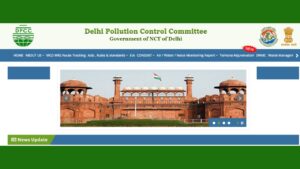
The Delhi Pollution Control Committee is the body that actually enforces pollution law within the National Capital Territory. Established on June 1, 1991, DPCC operates under the Department of Environment, Government of NCT of Delhi — and holds all the enforcement powers that CPCB delegated to it three decades ago.

For a full breakdown of DPCC’s functions, powers, and 2025–26 enforcement actions, read our detailed guide to the Delhi Pollution Control Committee. In summary, DPCC’s exclusive ground-level powers include:
Issuing and cancelling Consent to Establish (CTE) and Consent to Operate (CTO) certificates — the mandatory licences every industry in Delhi must hold to operate legally. No industry can legally function in Delhi without DPCC’s consent under Section 21 of the Air Act and Section 25 of the Water Act.
Operating Delhi’s Continuous Ambient Air Quality Monitoring Station (CAAQMS) network — the real-time data available at dpccairdata.com that feeds into CPCB’s national dashboard. Every neighbourhood-level AQI reading from Anand Vihar, Wazirpur, Rohini, and RK Puram comes from DPCC’s infrastructure.
Deploying enforcement teams across Delhi’s 33 sub-divisions and 11 revenue districts — especially active during the October to January winter pollution season when PM2.5 levels in areas like Jahangirpuri and Mundka routinely breach the Severe threshold.
In January 2026 alone, DPCC issued closure notices to 88 industrial units for failing to install Online Continuous Emission Monitoring Systems — direct ground-level enforcement that CPCB, operating at national scale, simply cannot replicate for individual Delhi factories.
CAQM — The Missing Piece Parliament Created in 2021
Here is the critical question: if CPCB sets the rules and DPCC enforces them in Delhi, why was a third body needed?
The answer is geography. Delhi’s pollution crisis does not respect state boundaries. Stubble burning in Punjab and Haryana contributes an estimated 30–40% of Delhi’s peak winter PM2.5 load. Industrial emissions from Ghaziabad and Faridabad in Uttar Pradesh and Haryana drift into Delhi. Construction activity in Greater Noida and Gurugram adds to the NCR’s overall particulate load.
CPCB had no authority to coordinate enforcement across multiple states simultaneously. DPCC had no jurisdiction beyond Delhi’s borders. The result was a coordination vacuum — and Delhi’s air quality suffered for it year after year.
The Commission for Air Quality Management in National Capital Region and Adjoining Areas was established as a statutory body under the CAQM Act, 2021 — an Act of Parliament passed specifically to fill this gap. CAQM has the authority to issue binding directions to Delhi, Haryana, Punjab, Rajasthan, and Uttar Pradesh simultaneously on matters affecting NCR air quality.
CAQM’s exclusive powers include:
- Activating and deactivating GRAP stages across the entire NCR — not just Delhi
- Issuing binding directions to all five NCR states and their respective pollution control boards
- Coordinating with the Supreme Court — CAQM reports directly to the Supreme Court in ongoing pollution cases including the landmark M.C. Mehta vs Union of India case
- Overriding conflicting state government decisions on matters affecting NCR air quality
- Commissioning and evaluating source apportionment studies — the research that determines what percentage of Delhi’s pollution comes from which source
A critical legal point: CAQM’s directions supersede those of state governments on NCR air quality matters. This means if Delhi Government wants to allow a category of construction that CAQM has banned under GRAP Stage 3, CAQM’s direction prevails.
The Chain of Command — Who Overrules Whom?
This is where most explanations fail. Here is the exact hierarchy:
| Level | Body | Authority |
|---|---|---|
| 1 — National standards | CPCB | Sets pollution limits for all of India |
| 2 — NCR coordination | CAQM | Issues binding directions across all NCR states |
| 3 — Delhi enforcement | DPCC | Enforces on the ground within NCT Delhi |
| 4 — Other NCR states | State PCBs | Enforce within Haryana, UP, Rajasthan respectively |
In practice during a pollution emergency:
- CPCB’s AQI data shows Delhi entering Very Poor territory
- CAQM activates GRAP Stage 3 across the entire NCR
- DPCC deploys enforcement teams across Delhi’s 33 sub-divisions
- Haryana and UP pollution control boards simultaneously restrict stubble burning and industrial activity in their respective NCR districts
No single body can do all four of these things. All three are needed simultaneously — which is why Delhi’s pollution response is structurally complex even when all three are functioning as intended.
Which Body Should Delhi Residents Contact for What?
| Problem | Who to Contact | Why |
|---|---|---|
| Factory near your home violating emission limits | DPCC | DPCC issues industrial consents and closure orders in Delhi |
| Construction site not using dust suppression | DPCC | DPCC runs the Dust Portal and deploys dust enforcement teams |
| Stubble burning smoke from Punjab or Haryana | CAQM | Only CAQM has cross-state jurisdiction |
| Incorrect AQI data from a monitoring station | DPCC | DPCC operates Delhi’s CAAQMS network |
| GRAP restrictions not being followed | CAQM + DPCC | CAQM activates GRAP, DPCC enforces it |
| National pollution standards query | CPCB | CPCB sets national ambient air quality standards |
| Reporting a Delhi industry without consent | DPCC | DPCC issues and revokes consents for Delhi industries |
How All Three Worked Together in 2025–26
The most recent example of all three bodies functioning in coordination is the Supreme Court’s January 2026 order in the M.C. Mehta vs Union of India case. The court directed CAQM — as the statutory expert body — to bring domain experts from IITs, research institutes, and NGOs together for a new source apportionment study for Delhi NCR.
CAQM convened the expert panel. CPCB provided the national data infrastructure and monitoring standards. DPCC contributed neighbourhood-level monitoring data from its CAAQMS network across Delhi. The resulting source apportionment findings directly inform which GRAP restrictions CAQM will activate in future pollution emergencies.
This three-way coordination is also visible in the year-round enforcement shift of 2025–26. CAQM issued directions requiring continuous rather than seasonal action. DPCC implemented those directions by deploying enforcement teams beyond the traditional October–January window. CPCB updated its monitoring data platform to support real-time compliance tracking.
The system works when all three coordinate. Delhi’s pollution data shows that the days it fails — when one body’s directions are not followed by another’s jurisdiction — are the days when AQI in areas like Anand Vihar and Rohini spikes beyond the Severe threshold with no effective on-ground response.
What This Means Going Forward
The structural gap that CAQM was created to fill in 2021 is now well understood. What remains unresolved is whether the coordination between all three bodies — and between Delhi and its neighbouring states — is fast enough and consistent enough to meaningfully reduce Delhi’s annual PM2.5 average from its 2025 level of 82.2 µg/m³.
CAQM’s GRAP framework has demonstrably reduced the worst Severe AQI days — CAQM’s own data shows Poor to Very Poor days declined from 186 days in 2018 to 157 days in 2025. But the annual average has not declined fast enough to meet NCAP’s 40% PM reduction target by 2026.
The next evolution of this three-body system will likely involve stronger CAQM enforcement powers over non-Delhi NCR states, real-time DPCC data integration into CAQM’s decision-making, and expanded CPCB monitoring infrastructure in areas that currently lack adequate station coverage.
Frequently Asked Questions (FAQs)
What is the difference between CPCB and DPCC?
CPCB (Central Pollution Control Board) is India’s national pollution standards authority — it sets the rules for all of India and delegates enforcement powers to state-level bodies. DPCC (Delhi Pollution Control Committee) is the body that received all of CPCB’s powers for Delhi via a 1991 notification and enforces them on the ground — issuing consents, monitoring stations, and sealing non-compliant industries.
What does CAQM stand for and what does it do?
CAQM stands for Commission for Air Quality Management in National Capital Region and Adjoining Areas. Established by an Act of Parliament in 2021, it is a statutory body with the power to issue binding directions on air quality to Delhi and four neighbouring states — Haryana, Punjab, Rajasthan, and Uttar Pradesh — simultaneously. It activates and deactivates GRAP stages and coordinates the inter-state pollution response.
Why was CAQM created when CPCB and DPCC already existed?
CPCB had no authority to enforce across multiple states, and DPCC’s jurisdiction ends at Delhi’s borders. Delhi’s pollution crisis — driven significantly by stubble burning from Punjab and Haryana and industrial emissions from NCR cities in UP and Haryana — needed a body that could act across all five states at once. CAQM was created specifically to fill this cross-state coordination gap.
Which body activates GRAP restrictions in Delhi?
CAQM activates all GRAP stages across Delhi NCR based on AQI forecasts and real-time monitoring data. DPCC then enforces GRAP restrictions on the ground within Delhi — deploying teams, issuing notices, and sealing violations. GRAP applies not just to Delhi but to the entire NCR region simultaneously under CAQM’s direction.
Does CAQM have more power than Delhi Government on pollution?
On air quality matters affecting the NCR, yes. The CAQM Act 2021 gives CAQM the authority to issue directions that supersede conflicting state government decisions across all NCR states. This means CAQM’s GRAP-related restrictions cannot be overridden by the Delhi Government or any of the four neighbouring state governments on matters falling within CAQM’s mandate.
Who should I contact to report a polluting factory in Delhi?
Contact DPCC — the Delhi Pollution Control Committee — to report a factory operating without consent or violating emission limits within Delhi. DPCC has the legal authority to inspect, issue notices, and seal non-compliant industrial units under the Air Act 1981 and Water Act 1974. For industries in NCR areas outside Delhi’s borders, contact the respective state pollution control board.
What is the CPCB national AQI dashboard and how does it work?
CPCB operates the national Central Control Room (CCR) dashboard at app.cpcbccr.com which aggregates real-time AQI data from monitoring stations across India. In Delhi, the station data feeding into this dashboard comes from DPCC’s CAAQMS network — available separately at dpccairdata.com. CPCB’s national dashboard and DPCC’s Delhi-specific data are two layers of the same monitoring system.

Nidhi Kapoor is an environmental journalist and air pollution monitoring expert with 8 years of experience. She specializes in collecting, analyzing, and interpreting air quality data to identify pollutant sources and their impact on public health. Through her investigative reporting, Nidhi develops insights and advocates for evidence-based solutions to reduce atmospheric contamination.