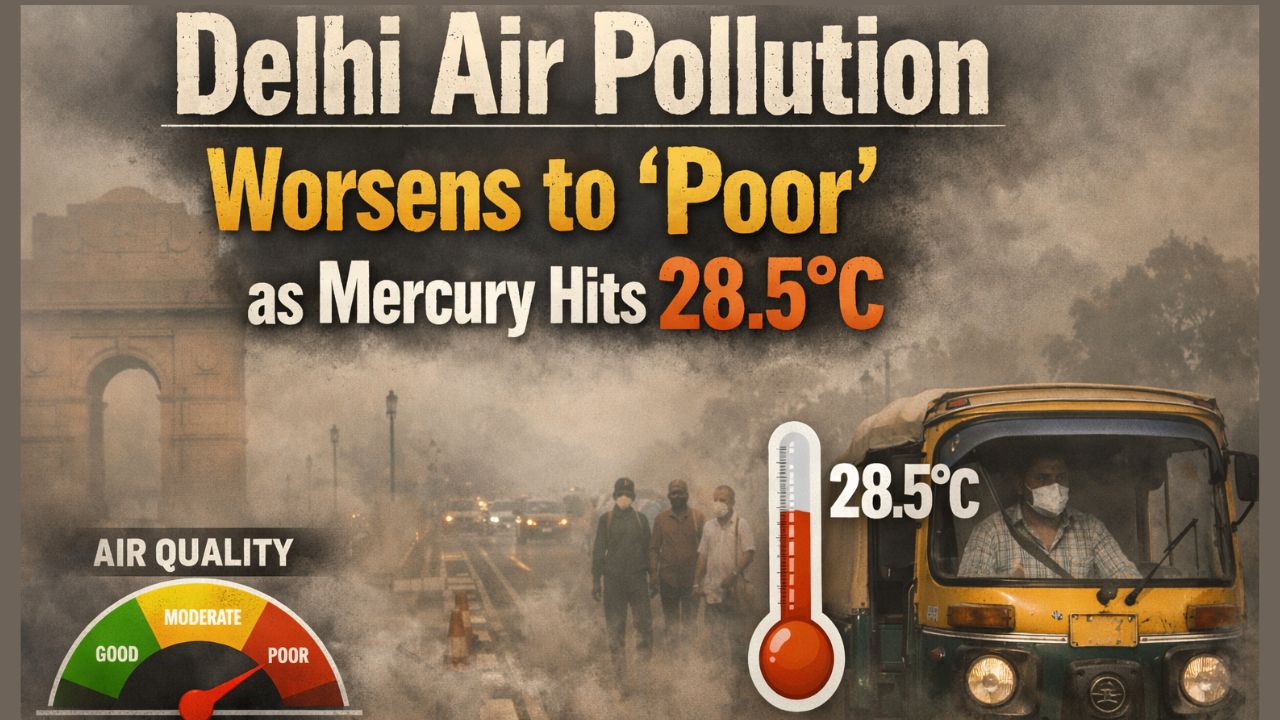
NEW DELHI: Delhi air pollution deteriorated on Sunday as the city recorded an Air Quality Index of 216 in the ‘poor’ category despite temperatures climbing to 28.5 degrees Celsius, 4.1 notches above seasonal average, according to the Central Pollution Control Board and India Meteorological Department.
The capital recorded a maximum temperature of 28.5 degrees Celsius on February 15, 2026, while the minimum settled at 11.1 degrees Celsius, marginally above normal, IMD data showed. The warmer weather conditions, however, did not translate into improved air quality, with the AQI remaining firmly in the unhealthy range at 4 pm.
Delhi Air Quality Index Today: Poor Category Persists
The Delhi air quality index reading of 216 at 4 pm Sunday placed it in the ‘poor’ category, indicating air quality that could cause breathing discomfort to people with lung, asthma, and heart diseases. This marked a slight improvement from the morning AQI of 221 recorded around 7 am, but remained substantially worse than the ‘moderate’ threshold of 200.
According to CPCB classification, AQI between 201 and 300 falls under ‘poor’ category, while 301 to 400 is ‘very poor’ and 401 to 500 is ‘severe’. Sunday’s delhi aqi today reflects persistent air quality concerns even as winter conditions ease across North India.
Temperature Spike Amid Smog Conditions
Relative humidity ranged from 89 percent at 8:30 am to 45 percent at 5:30 pm on Sunday, creating conditions conducive to smog formation. The IMD has forecast mist for Monday, with maximum and minimum temperatures expected around 28 degrees Celsius and 12 degrees Celsius respectively.
The significant temperature rise—4.1 degrees above normal—marks one of the earliest warm spells Delhi has witnessed in mid-February over the past two years. In both 2024 and 2025, minimum temperatures stayed below 13 degrees Celsius during the first half of February, making this year’s warmth unusual for the season.
What This Means for Residents
The combination of rising temperatures and poor air quality creates challenging conditions for Delhi residents. Health experts recommend limiting outdoor physical activities during peak pollution hours, typically morning and evening times when pollutant concentrations are highest.
Children, elderly individuals, and those with pre-existing respiratory or cardiac conditions face elevated health risks at current pollution levels. Symptoms may include coughing, throat irritation, breathing difficulties, and eye discomfort. Residents should consider using N95 masks when stepping outdoors and air purifiers indoors.
The poor delhi air pollution today affects daily commuting patterns as well, with reduced visibility during morning hours impacting road traffic and flight operations at Indira Gandhi International Airport.
Weather Outlook: Rain Expected Next Week in Delhi
The India Meteorological Department has predicted that a fresh Western Disturbance will arrive on Monday, February 16, bringing the likelihood of rainfall over North India including Delhi. Isolated rainfall or thundershowers are expected over northwest plains on February 17 and 18, 2026.
Weather experts suggest the approaching rain system could provide temporary relief from air pollution, as precipitation helps wash down suspended particulate matter. However, widespread or prolonged rainfall appears unlikely, with only brief passing showers expected in some areas.
Current meteorological conditions show predominantly light winds, which contribute to pollutant accumulation rather than dispersion. Wind speeds are expected to remain below 15 kmph through Monday, limiting natural cleansing of the atmosphere.
Monitoring Data Shows Variation Across Delhi
Air quality readings varied across Delhi’s 40 monitoring stations on Sunday. While the overall AQI stood at 216-221, individual stations recorded readings ranging from 140 in some locations to 316 in others. Areas with higher vehicular traffic and industrial activity typically showed worse air quality than green zones and residential neighborhoods.
PM2.5 levels—fine particulate matter smaller than 2.5 micrometers that can penetrate deep into lungs—remained the primary pollutant of concern. These microscopic particles originate from vehicular emissions, construction dust, industrial discharge, and biomass burning.
The warming trend and stable atmospheric conditions create an inversion layer that traps pollutants close to ground level, preventing their vertical dispersion. This phenomenon is common during transition periods between seasons.

Nidhi Kapoor is an environmental journalist and air pollution monitoring expert with 8 years of experience. She specializes in collecting, analyzing, and interpreting air quality data to identify pollutant sources and their impact on public health. Through her investigative reporting, Nidhi develops insights and advocates for evidence-based solutions to reduce atmospheric contamination.