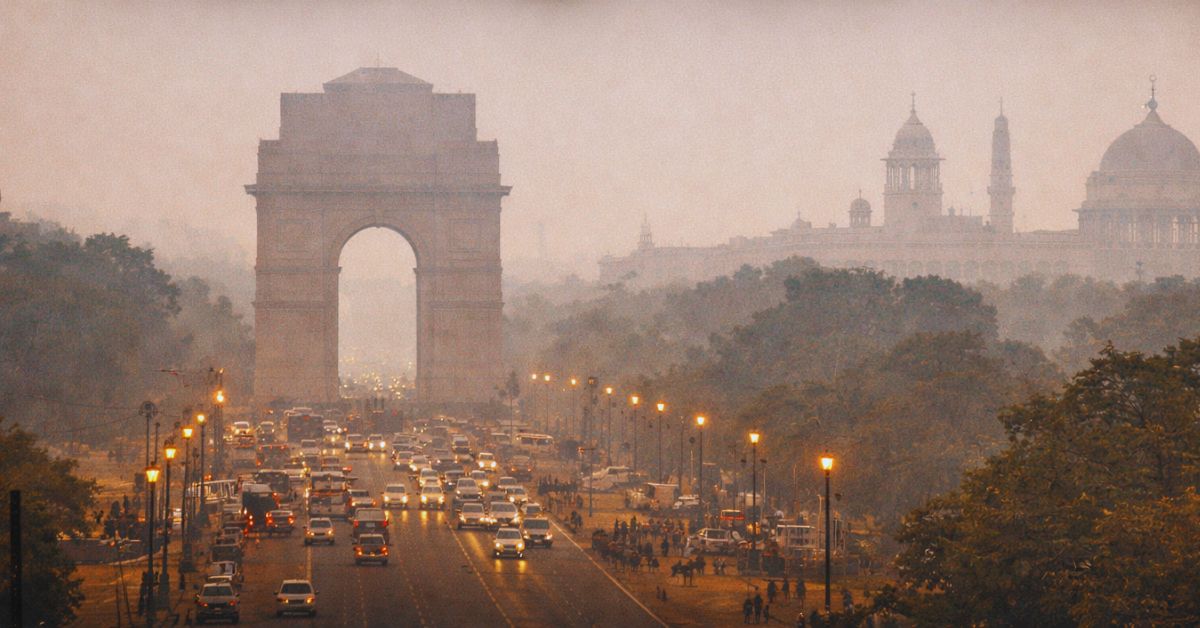
New Delhi, February 22, 2026: As February draws to a close, Delhi’s air quality has remained a focal point for residents and policy planners. Following the recent revocation of GRAP Stage-II restrictions, the National Capital Region (NCR) has seen a stabilization in pollution levels, though experts emphasize that “moderate” air does not mean “hazard-free.”
Delhi AQI Weekly Trends and Forecast Performance (Feb 16–22)
Data from the Central Pollution Control Board (CPCB) highlights the impact of shifting wind patterns and warmer-than-average temperatures on the region’s particulate matter (PM) concentration.
| Date | Avg AQI | Category | Status |
| Feb 16 | 261 | Poor | GRAP-II Active |
| Feb 17 | 249 | Poor | GRAP-II Active |
| Feb 18 | 214 | Poor | GRAP-II Revoked |
| Feb 22 | 197 | Moderate | Stable |
The Meteorological Drivers
Current data indicates that warmer temperatures (reaching 29°C–31°C) and northwest wind shifts have assisted in the dispersion of pollutants. However, with wind speeds expected to drop to less than 5 kmph in the coming nights, the local concentration of PM2.5 remains a challenge.
Expert Perspective: What This Means for Residents
While the shift to “Moderate” AQI levels (below 200) offers relief, the Commission for Air Quality Management (CAQM) continues to urge caution. The recent Supreme Court briefing highlighted that vehicular emissions remain the highest long-term contributor to Delhi’s air pollution.
“Data-driven vigilance is our best tool. While current conditions are favorable for dispersion, the underlying emission sources—primarily transport and industrial output—require sustained monitoring rather than just seasonal interventions.”
— Environmental Policy Analyst, [Nidhi Kapoor]
Looking Ahead: The Forecast
Meteorological forecasts from the Air Quality Early Warning System (IITM) suggest that air quality will likely hover in the ‘Poor’ to ‘Moderate’ category through February 25. Residents are advised to:
- Monitor daily AQI bulletins before planning strenuous outdoor activity.
- Utilize local air purifiers during low-wind evening hours.
- Check official CPCB real-time data for hyper-local updates.
Data References:
- Central Pollution Control Board (CPCB) Daily Bulletins.
- Air Quality Early Warning System (IITM), Ministry of Earth Sciences.
- CAQM Statutory Directions (February 2026 Review).
New Delhi, February 22, 2026: In a major policy shift to curb air pollution, the Commission for Air Quality Management (CAQM) has issued two critical statutory directions—No. 98 and No. 97—aimed at tightening control over industrial emissions and construction-related dust across the National Capital Region (NCR).
These measures follow scientific assessments by the Indian Institute of Technology (IIT) Kanpur and recommendations from the Central Pollution Control Board (CPCB), identifying industrial stack emissions and construction dust as primary contributors to the region’s elevated particulate matter (PM) levels.
1. Stricter Emission Norms for Industries (Statutory Direction No. 98)
The CAQM has established a new, uniform emission standard for particulate matter to replace existing limits for identified industries.
- New PM Limit: A mandatory maximum permissible limit of 50 mg/Nm³ (milligrams per normal cubic metre) has been set.
- Applicability: The standard applies to 17 categories of highly polluting industries (CPCB-identified), Red Category (medium and large) units, food processing plants, textile units with boilers or thermic fluid heaters, and metal industries operating furnaces.
- Exemptions: Industries already subject to a stricter PM limit (below 50 mg/Nm³) under current statutory provisions are exempt from this new requirement.
- Compliance Schedule:
- Large and Medium Industries: Effective from August 1, 2026.
- Remaining Targeted Industries: Effective from October 1, 2026.
2. New Construction & Demolition (C&D) Waste Management (Statutory Direction No. 97)
To address dust pollution from large-scale construction activities, the CAQM has streamlined waste management procedures, effective April 1, 2026.
- Waste Declaration: Authorities approving building plans must now obtain a declaration of estimated demolition waste for all projects with a plot area of 200 sqm or more.
- Mandatory Receipts: Project proponents must deposit demolition waste at designated collection or processing facilities and obtain a receipt. Verification of this receipt is now mandatory for issuance of Completion or Occupation Certificates.
- Infrastructure Requirements: Municipal bodies are tasked with establishing at least one waste collection point for every 5 km x 5 km grid.
- Tech-Driven Monitoring: State governments and the GNCTD have been directed to implement an integrated web portal featuring geo-tagging of waste facilities and GPS tracking for waste transportation vehicles.
Commitment to Regional Air Quality
The CAQM has instructed State Pollution Control Boards, the Delhi Pollution Control Committee, and relevant NCR authorities to ensure full compliance. Beyond enforcement, these bodies are required to conduct intensive Information, Education, and Communication (IEC) campaigns to ensure all industrial and construction stakeholders are sensitized to these new standards.
These regulatory actions represent a targeted, science-based approach to mitigating secondary particulate formation, ultimately aimed at improving the overall ambient air quality for residents across the Delhi-NCR region.

Nidhi Kapoor is an environmental journalist and air pollution monitoring expert with 8 years of experience. She specializes in collecting, analyzing, and interpreting air quality data to identify pollutant sources and their impact on public health. Through her investigative reporting, Nidhi develops insights and advocates for evidence-based solutions to reduce atmospheric contamination.