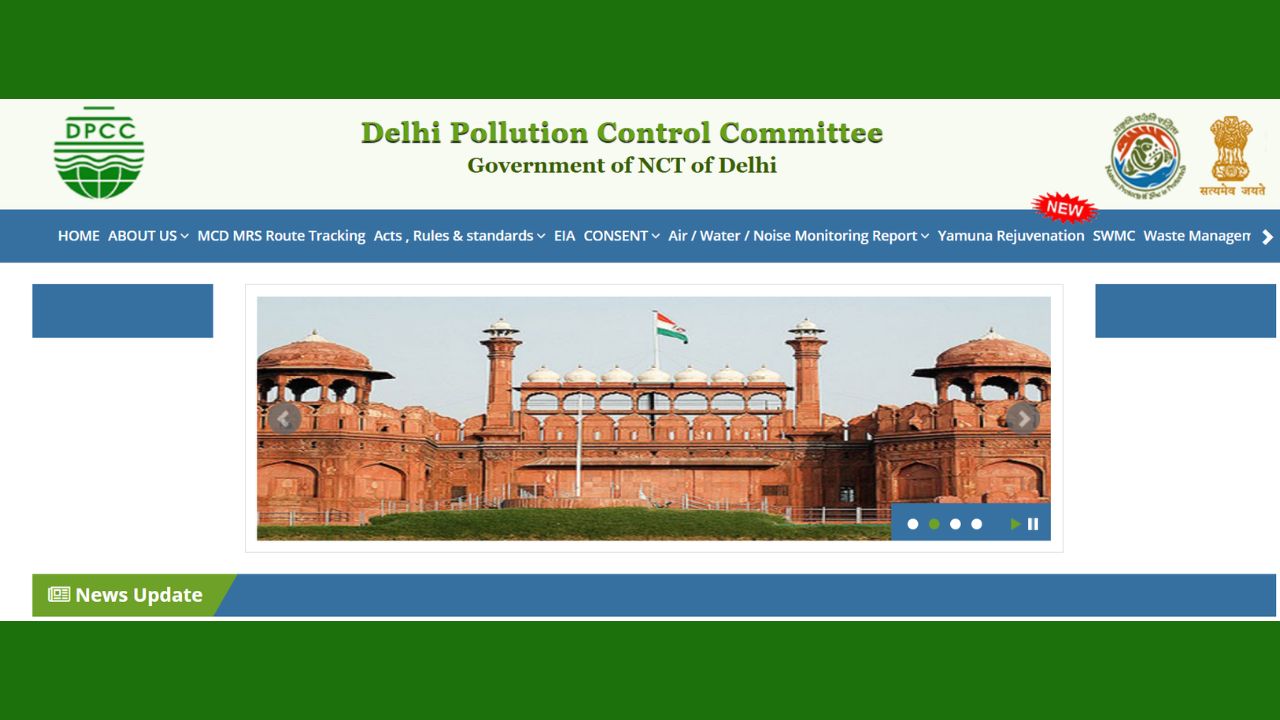
Every time Delhi’s AQI spikes and enforcement teams seal an industrial unit or slap a fine on a construction site, it is the Delhi Pollution Control Committee — DPCC — behind that action. Yet most Delhi residents have never heard of it. Here is a complete, plain-language guide to what DPCC is, what powers it holds, how it differs from CPCB and CAQM, and what it has actually done in 2025–26 to clean Delhi’s air.
What Is DPCC and When Was It Created?
The Delhi Pollution Control Committee is an autonomous regulatory body that came into existence on June 1, 1991. It was created after the Central Pollution Control Board (CPCB) formally delegated all its powers and functions to DPCC via a notification dated March 15, 1991 — covering the entire National Capital Territory of Delhi.
DPCC functions under the Department of Environment, Government of NCT of Delhi, and is headed by its Chairman — the Secretary (Environment & Forest) of the Delhi Government. Its legal authority derives from two central laws: the Air (Prevention and Control of Pollution) Act, 1981, and the Water (Prevention and Control of Pollution) Act, 1974.
In simple terms, DPCC is the body that actually enforces pollution law at the ground level in Delhi — giving it powers that go far beyond monitoring numbers on a screen.
DPCC vs CPCB vs CAQM — What Is the Difference?
This is the question no competitor article answers clearly. Here is the exact distinction:
| Body | Full Name | Role | Geographic Scope |
|---|---|---|---|
| CPCB | Central Pollution Control Board | National apex body — sets standards, delegates powers | All of India |
| DPCC | Delhi Pollution Control Committee | Implements CPCB’s powers at state level in Delhi | NCT of Delhi only |
| CAQM | Commission for Air Quality Management | Emergency and policy coordination for NCR air quality | Delhi + NCR states |
| DPCC + CAQM | Working together | CAQM issues directions, DPCC enforces them on the ground | Delhi NCR |
The key insight: CPCB makes the rules. CAQM coordinates the emergency response. DPCC is the body that actually shows up at your factory, construction site, or neighbourhood and takes action.
What Are DPCC’s Main Functions?
DPCC’s work covers six core areas that directly affect Delhi’s air and water quality:
1. Air Quality Monitoring DPCC operates a network of Continuous Ambient Air Quality Monitoring Stations (CAAQMS) across Delhi. Real-time data from these stations is publicly available at dpccairdata.com — the same data that feeds into CPCB’s national AQI dashboard. Stations in areas like Anand Vihar, Wazirpur, Okhla, and Rohini provide the neighbourhood-level readings that Delhi residents check daily.
2. Industrial Consent and Enforcement No industry in Delhi can legally operate without DPCC’s prior consent under Section 21 of the Air Act and Section 25 of the Water Act. DPCC issues Consent to Establish (before construction) and Consent to Operate (before production begins). Industries in Green and Orange categories must obtain these certificates — and DPCC has the power to cancel them, seal units, or impose Environmental Compensation charges for violations.
In January 2026, DPCC issued closure notices to 88 industrial units across Delhi for failing to install Online Continuous Emission Monitoring Systems (OCEMS) — a direct enforcement action under CAQM Direction No. 76. This is the kind of ground-level action that directly determines how many polluting units are actually operating in the city at any given time.
3. Construction and Dust Pollution Control Construction dust is one of Delhi’s most persistent year-round pollutants. DPCC manages a dedicated Dust Portal — a mandatory registration system that requires any construction or demolition project to register and demonstrate dust mitigation measures before the Municipal Corporation of Delhi issues a building sanction plan.
DPCC also deployed teams across 33 sub-divisions in 11 revenue districts during the winter season of 2025–26 specifically to monitor and penalise dust pollution from road-cutting and construction sites.

4. Hazardous and Biomedical Waste Hospitals, clinics, blood banks, and animal clinics in Delhi must obtain DPCC authorisation for handling biomedical waste. DPCC also regulates hazardous waste generation, storage, transportation, and disposal — covering everything from battery waste to e-waste from industrial units. In June 2025, DPCC coordinated the lifting and recycling of e-waste seized during a joint enforcement drive in Mustafabad.
5. Environmental Impact Assessment For major projects — including waste-to-energy plants, industrial expansions, and large infrastructure works — DPCC conducts or reviews Environmental Impact Assessments (EIAs) and holds public hearings. Recent examples include the proposed expansion of the Tehkhand Waste to Energy Plant to 45 MW and the Okhla Waste Management Company’s expansion to 40 MW.
6. Water Quality and Sewage Standards DPCC sets standards for sewage treatment and trade effluent discharge into Delhi’s water bodies, including the Yamuna. Industries discharging effluents require DPCC consent under the Water Act — and violations trigger the same enforcement powers available for air pollution.
What Has DPCC Actually Done in 2025–26?
This is where most articles about DPCC stop at theory. Here is what the Committee has actually delivered on the ground in the current period:
DPCC and CAQM jointly moved to a year-round action plan in 2025–26 — replacing the previous approach of emergency shutdowns only during winter. This means enforcement is now continuous rather than seasonal, which is a significant shift in how Delhi’s pollution problem is being managed.
Three specialised panels were formed to evaluate over 270 technological solutions submitted in response to DPCC’s Innovation Challenge — covering everything from photocatalytic road coatings to smog-eating surfaces. The Delhi Government’s partnership with IIT-Madras on smog-eating surface technology, announced in March 2026, came directly from this process.
DPCC issued direction in December 2025 banning any diesel generator that has not been retrofitted with anti-pollution devices — covering both domestic and commercial users across the entire NCT. This addresses a significant but underreported source of particulate matter in Delhi’s air.
The Dust Portal 2.0 upgrade — covering AMC and upgradation of DPCC’s dust pollution self-assessment portal and mobile app — was tendered in 2025, improving the real-time monitoring of construction dust across the city.
What Does DPCC Mean for You as a Delhi Resident?
DPCC’s work touches Delhi residents’ lives in three direct ways that are rarely explained:
If you live near an industrial area — Wazirpur, Okhla, Bawana, Mundka — DPCC is the body responsible for ensuring those industries have valid consents and are not violating emission limits. Every closure notice DPCC issues to a non-compliant unit in your neighbourhood directly improves your local air quality.
If you live near a construction site — DPCC’s Dust Portal and winter enforcement teams are the mechanism through which construction projects are legally required to use anti-smog guns, covered trucks, and dust suppression systems. You can report violations to DPCC directly.
If you check Delhi’s AQI daily — the monitoring station data you see on SAFAR, IQAir, or government apps comes from DPCC’s CAAQMS network. Without DPCC’s monitoring infrastructure, there would be no real-time, station-level AQI data for Delhi.
What This Means Going Forward
DPCC’s shift to year-round enforcement in 2025–26 is the most significant structural change in Delhi’s pollution control approach in several years. The previous model — intense winter crackdowns followed by lighter monitoring in other seasons — allowed chronic polluters to operate with minimal scrutiny for most of the year. Year-round enforcement closes that gap.
The effectiveness of this approach will become clear in the IQAir World Air Quality Report 2026, expected in early 2027. If Delhi’s annual PM2.5 average — 82.2 µg/m³ in 2025 — shows meaningful decline, year-round DPCC enforcement will be a major contributing factor. If it does not, the pressure on DPCC and CAQM to escalate their tools will intensify significantly.
Frequently Asked Questions (FAQs)
What is the full form of DPCC in Delhi?
DPCC stands for Delhi Pollution Control Committee. It is an autonomous regulatory body established on June 1, 1991, under the Department of Environment, Government of NCT of Delhi. DPCC enforces air, water, and noise pollution control laws across the entire National Capital Territory of Delhi.
What is the difference between DPCC and CPCB?
CPCB (Central Pollution Control Board) is India’s national apex pollution authority that sets standards and policies for the entire country. DPCC is the body to which CPCB delegated all its powers specifically for Delhi via a 1991 notification. In practice, CPCB makes the rules — DPCC enforces them on the ground in Delhi.
What does DPCC do for air quality in Delhi?
DPCC monitors real-time air quality through its CAAQMS station network, issues and cancels industry operating consents, enforces construction dust regulations through its Dust Portal, deploys winter enforcement teams across Delhi’s 33 sub-divisions, and takes closure action against non-compliant industrial units. In January 2026 alone, DPCC issued closure notices to 88 industrial units for failing to install emission monitoring systems.
How do I check air quality data for Delhi?
DPCC’s real-time ambient air quality data is publicly available at dpccairdata.com. The data covers all CAAQMS monitoring stations across Delhi including Anand Vihar, Wazirpur, Rohini, RK Puram, Okhla, and other key locations — updated continuously throughout the day.
What is the DPCC Dust Portal?
The DPCC Dust Portal is a mandatory online registration system for construction and demolition projects in Delhi. Any project must register on the portal and demonstrate dust mitigation measures before the Municipal Corporation of Delhi will issue a building sanction plan. The portal was upgraded to Dust Portal 2.0 in 2025 with improved monitoring and mobile app functionality.
Can the Committee seal or close industrial units in Delhi?
Yes. DPCC has full legal authority under the Air Act 1981 and Water Act 1974 to issue closure orders and sealing directions to non-compliant industries in Delhi. In 2025–26, DPCC issued closure notices to 88 industrial units that failed to install Online Continuous Emission Monitoring Systems as required under CAQM Direction No. 76.
What is the DPCC consent certificate and who needs it?
A DPCC consent certificate — formally called Consent to Establish (CTE) and Consent to Operate (CTO) — is a mandatory licence required by any industry operating in Delhi’s air pollution control area. It is required under Section 21 of the Air Act and Section 25 of the Water Act. Industries in Green and Orange categories must obtain these certificates, and operating without them is a legal violation subject to closure action.
Please note we are not linked to any Govt agency or the DPCC. If you have any questions related to this article or require support, you can use the DPCC official website for more info.

I’am Siddharth a Air pollution analysts are environmental expert who collect, analyze, and interpret air quality data to identify pollutant sources & develop solutions for reducing atmospheric contamination.