
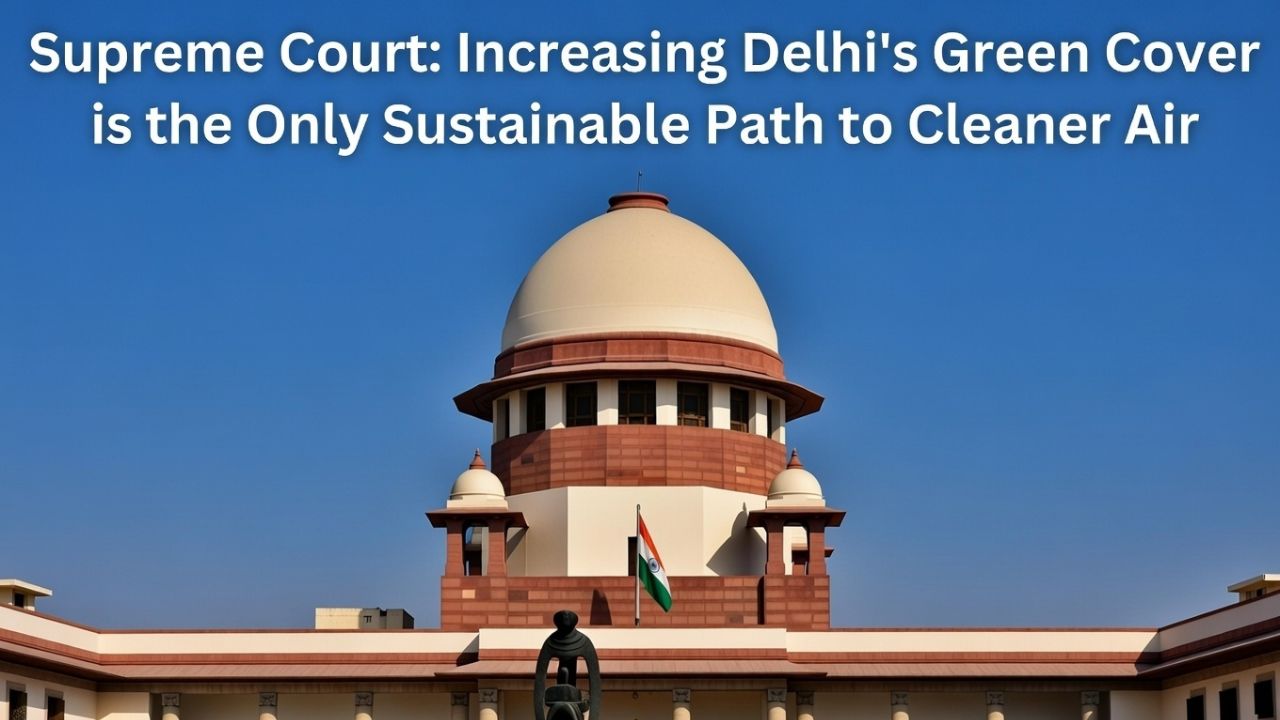
Supreme Court: Increasing Delhi’s Green Cover is the Only Sustainable Path to Cleaner Air
New Delhi, February 21, 2026: In a significant move toward long-term environmental restoration, the Supreme Court of India has reiterated that boosting the national capital’s green cover is the most effective and sustainable strategy to combat persistent air pollution. During a recent hearing, the Court highlighted that while daily monitoring of the Air Quality Index (AQI) is essential for immediate alerts, a permanent solution requires a structural increase in greenery.
The Court’s Vision for a Greener Delhi
A bench headed by Chief Justice of India (CJI) Surya Kant noted the direct connection between the city’s green infrastructure and its overall air quality. The Court is currently overseeing the progress of an expert committee tasked with supervising the afforestation program intended to compensate for the felling of trees in the Delhi Ridge area. The bench emphasized that this initiative is a well-thought-out, long-term solution that holds critical relevance to improving the city’s AQI.
Roadmap for Afforestation: Key Data Points
To move from policy to implementation, the Forest Research Institute (FRI) has proposed a comprehensive plan. The initiative focuses on scaling Delhi’s green cover to 33% of its total land area.
| Initiative | Projected Scope / Details |
| Target Green Cover | 33% of Delhi’s land area |
| Tree Census Cost | ₹4.43 crore (using geospatial mapping) |
| Greening Project Cost | ₹3.69 crore |
| New Expert Member | MD Sinha (Former IFS Officer) |
| Current Forest/Tree Cover | ~25% (approx. 371.31 sq km) |
Strengthening the Oversight Committee
To ensure accountability, the Supreme Court has expanded the expert advisory panel. The committee, which already includes former Principal Chief Conservator of Forests Sunil Limaye and environmentalist Pradip Kishen, now includes MD Sinha, a former Indian Forest Service officer. This committee will work alongside a high-level steering committee led by the Delhi Chief Secretary to identify suitable land for new plantations and oversee the upcoming tree census.
The Verdict: A Collaborative Effort
The Supreme Court’s focus remains on filling administrative vacancies to ensure that afforestation plans do not face further delays. By tasking experts with revising budgets and timelines, the Court is ensuring that the transition from draft plans to ground-level planting is both transparent and scientifically sound. The judiciary has stressed that while urban development is necessary, it must be balanced with the environmental imperatives of a growing city.
Looking Ahead
While immediate measures like the Graded Response Action Plan (GRAP) help manage air quality during peak pollution days, the Supreme Court’s emphasis on afforestation offers a hopeful, long-term perspective. With the revised timelines and a specialized expert committee now in place, the focus for Delhi will shift toward sustainable growth—ensuring that the national capital moves closer to its target of 33% green cover. As the city continues to navigate seasonal weather patterns, these efforts represent a positive, data-driven step toward a healthier future for all residents.

Nidhi Kapoor is an environmental journalist and air pollution monitoring expert with 8 years of experience. She specializes in collecting, analyzing, and interpreting air quality data to identify pollutant sources and their impact on public health. Through her investigative reporting, Nidhi develops insights and advocates for evidence-based solutions to reduce atmospheric contamination.