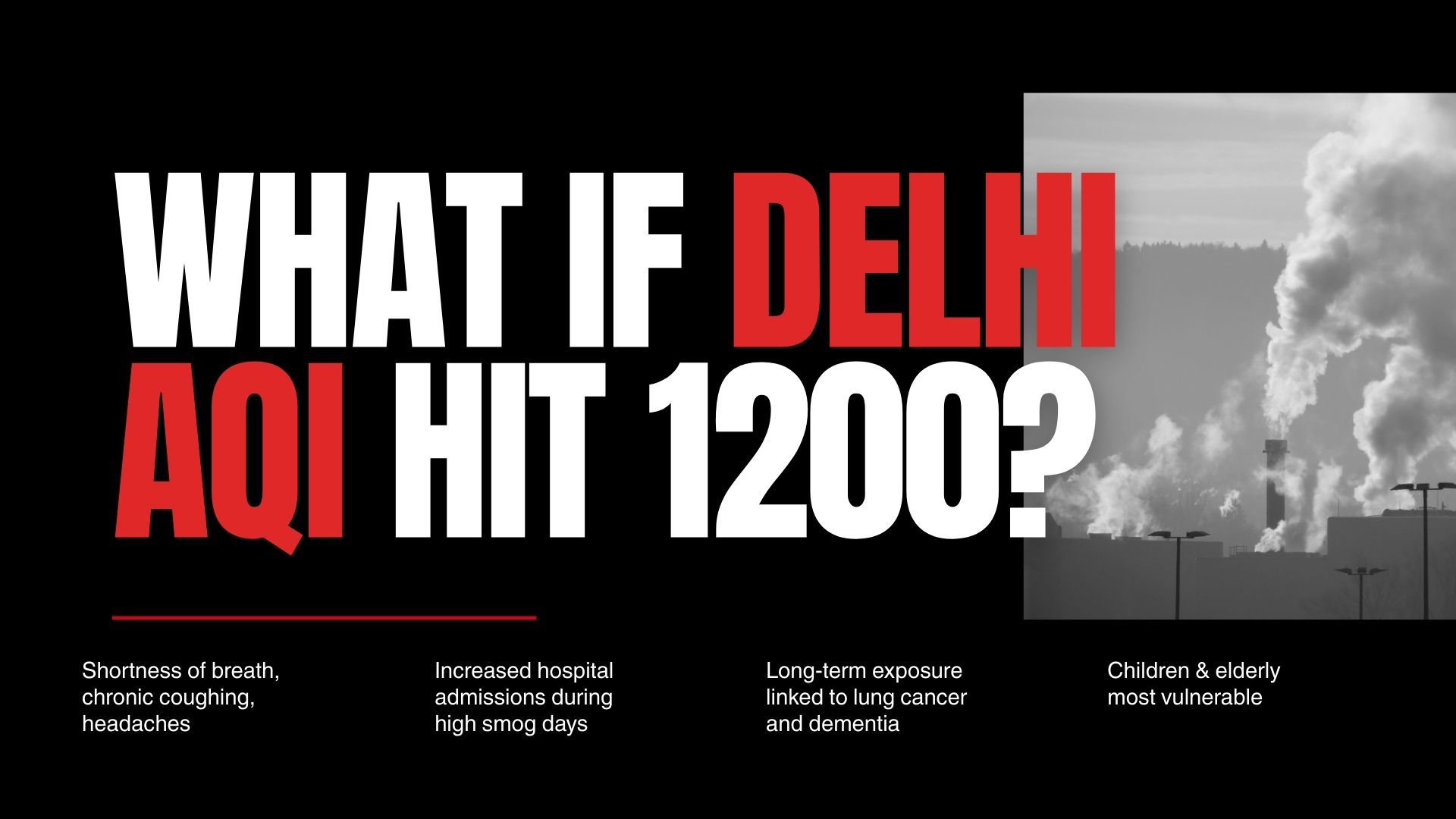
Nowadays, many experts are discussing what would happen if Delhi’s AQI Hit 1200? New Delhi, February 8, 2026 – Delhi’s air quality remains a persistent concern this winter, with current CPCB readings hovering in the ‘poor’ to ‘unhealthy’ range—around 196–227 overall, and some stations showing higher spikes. Independent monitors like IQAir report US AQI equivalents in the 150–200 range, driven by PM2.5 levels often exceeding 60–90 µg/m³, far above WHO guidelines.
While India’s official AQI scale caps severe readings at 500, with “severe plus” beyond that, historical extremes, like localized spikes near 795 in November 2024, or raw pollutant equivalents going even higher during past crises, prompt experts to warn about the disastrous effects of an AQI reaching 1200. This extreme scenario would mean pollution levels far worse than any recorded norm, similar to breathing air like smoking dozens of cigarettes every day.
In a detailed conversation about the potential impacts, Dr. Anumita Roychowdhury, Executive Director of Research and Advocacy at the Centre for Science and Environment (CSE), shared her deep concern based on years of data and real-life experiences. “We’ve already seen heartbreaking effects at current levels. Children are missing school, families are cancelling outings, and elderly loved ones are struggling to breathe,” she said with emotion. “An AQI of 1200 would greatly increase this suffering. It would feel like a city-wide emergency where every breath causes pain.”

Immediate and Long-Term Health Impacts Dr. Roychowdhury highlighted the profound human suffering: acute respiratory distress, severe asthma attacks, eye and throat irritation, and cardiovascular strain would surge. Vulnerable groups—children, pregnant women, and the elderly—would bear the heaviest burden. “Parents would watch helplessly as their kids cough through sleepless nights; expectant mothers face heightened risks of preterm births or developmental issues in their babies,” she said, her tone reflecting genuine worry. Long-term exposure at such extremes could accelerate chronic conditions like lung cancer, heart disease, dementia, and reduced life expectancy—already shortened by 8–12 years in Delhi due to ongoing pollution.
Delhi People’s Health & Economic Impacts at Extreme AQI Levels (Hypothetical Scenario)
| Impact Category | Immediate Effects (Days/Weeks) | Long-Term Effects (Months/Years) | Estimated Scale at AQI 1200 Equivalent |
|---|---|---|---|
| Respiratory Health | Severe coughing, wheezing, asthma exacerbations, hospital surges | Chronic bronchitis, COPD, lung function decline | 30–50%+ increase in cases; hospitals overwhelmed |
| Cardiovascular | Heart attacks, strokes in vulnerable individuals | Hypertension, heart disease progression | Significant rise in emergencies |
| Vulnerable Groups | Children: growth impacts; Elderly: mobility loss; Pregnant: preterm risks | Reduced life expectancy (additional years lost) | Highest toll on families |
| Other Effects | Headaches, fatigue, skin/eye irritation, brain inflammation | Increased dementia/Alzheimer’s risk, fertility issues | Widespread daily misery |
| Economic Cost | Lost workdays, productivity drop (8–10% per high day) | Billions in healthcare, premature deaths, GDP loss | Potential additional billions in NCR losses |
| Productivity Loss | Absenteeism, reduced output, business halts | 1–2 billion+ lost working days nationally (scaled up) | Major sectors paralyzed |
Broader Human and Societal Toll: The emotional weight is immense. “It’s not just physical—it’s the stolen moments: kids unable to play outdoors, families feeling imprisoned indoors, a constant undercurrent of anxiety,” Dr. Roychowdhury reflected. Visibility drops to near-zero would heighten road accidents and flight disruptions, while ecosystems suffer from acid rain and soil degradation, indirectly affecting food security.
Economically, the impact would be severe. Dr. Roychowdhury referenced reports from the Clean Air Fund and Dalberg Advisors, stating that air pollution currently costs India $95 billion each year due to lost productivity, absenteeism (1.3 billion workdays lost), and healthcare costs. “At 1200 AQI, the National Capital Region could see immediate GDP losses in the billions; retail foot traffic would disappear, construction would stop, tourism would fade, and investments would leave,” she warned. Delhi alone has experienced losses equivalent to 6% of its GDP in particularly bad years. An extreme event would worsen this damage.

Path Forward Amid Hope Despite the grim outlook, Dr. Roychowdhury remains cautiously optimistic. “We’ve seen incremental improvements through GRAP measures, EV adoption, and better stubble management in some seasons. But true change demands urgent, unified action: stricter enforcement, expanded public transport, clean energy transitions, and regional cooperation,” she urged. “This isn’t inevitable—it’s a crisis we can still prevent from becoming our legacy. Every breath we fight for matters for our children and future generations.”
This analysis draws from current CPCB and IQAir data, historical records, AQLI reports, CSE insights, and economic studies from Clean Air Fund/Dalberg, emphasising the urgent need for sustained action as Delhi navigates its ongoing air quality challenges.
I’am Siddharth a Air pollution analysts are environmental expert who collect, analyze, and interpret air quality data to identify pollutant sources & develop solutions for reducing atmospheric contamination.