
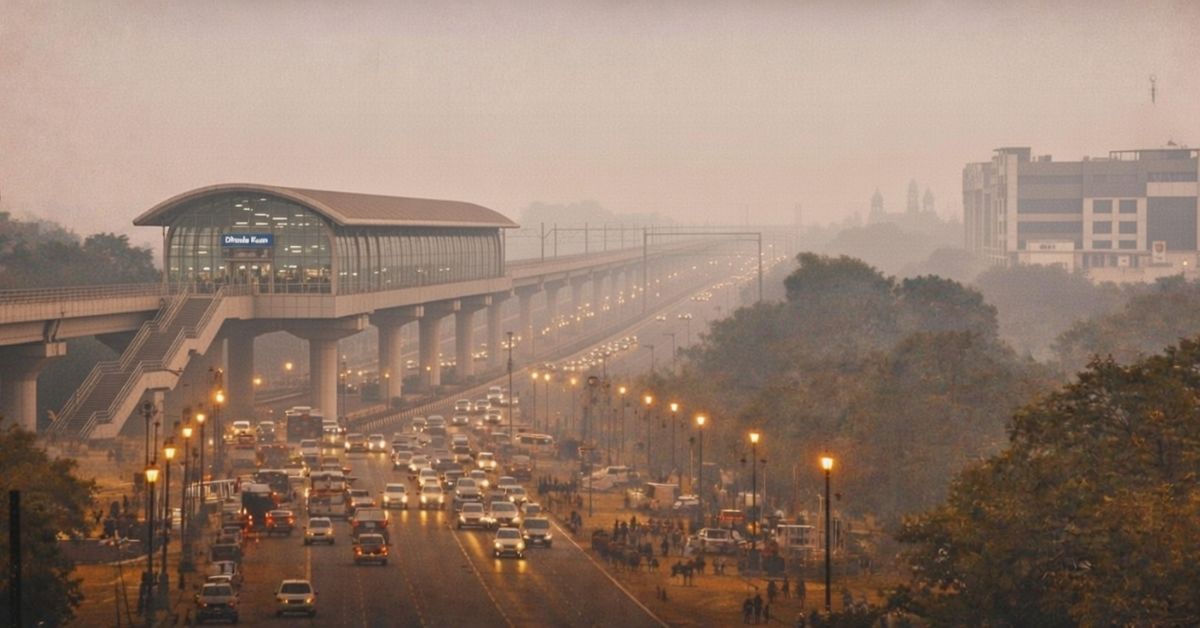
Will Delhi Air Quality Turn ‘Poor’ Again This Week? Delhi’s recent improvement in air quality may prove temporary, as weather conditions are likely to become less favourable for pollutant dispersion later this week, according to the latest forecast issued by the India Meteorological Department (IMD). After briefly slipping into the “moderate” Air Quality Index (AQI) category, pollution levels in the national capital could rise again, potentially entering the “poor” range.
Official air quality data from the Central Pollution Control Board (CPCB) shows Delhi’s 24-hour average AQI hovering between 170 and 190 over the past few days. This improvement followed a period of stronger surface winds and better atmospheric mixing, which helped disperse accumulated pollutants. However, experts stress that this relief is meteorological, not structural, and therefore vulnerable to reversal.
India Meteorological Department (IMD) Forecast on Delhi Air Quality Update
According to the IMD’s short-range forecast, wind speed across Delhi and the surrounding NCR region is expected to weaken, while atmospheric stability may increase. Such conditions often reduce vertical dispersion, allowing fine particulate matter — especially PM2.5 and PM10 — to accumulate near ground level. Historically, similar weather patterns have resulted in rapid AQI deterioration, even within 24 to 48 hours.
Environmental analysts point out that emission sources across Delhi-NCR remain largely unchanged. Vehicular emissions during peak traffic hours, resuspension of road dust, construction activity, and regional pollution transport from neighbouring areas continue to exert pressure on air quality. Without sustained winds or rainfall, these pollutants can quickly push AQI levels back into the “poor” or even “very poor” category.
From a public health perspective, doctors advise residents not to lower their guard. Even moderate AQI levels can aggravate respiratory symptoms, eye irritation, reduced lung function, and cardiovascular stress, particularly among children, elderly individuals, and people with asthma or chronic heart conditions. Health experts recommend avoiding outdoor exercise during early morning and late evening hours, when pollution levels typically peak.
Government agencies are monitoring the situation under the Graded Response Action Plan (GRAP) framework. Officials have indicated that preventive and control measures—including stricter dust management at construction sites, enhanced road sweeping, and closer monitoring of diesel vehicle emissions—may be escalated if air quality worsens.
In summary, while Delhi is currently experiencing short-term relief from hazardous pollution levels, the IMD forecast suggests that air quality may turn ‘poor’ again later this week if weather conditions deteriorate. Experts emphasize that lasting improvement will require consistent emission control and long-term policy enforcement, not just favourable meteorology. Residents are advised to monitor daily AQI updates and take necessary precautions as conditions evolve.

Nidhi Kapoor is an environmental journalist and air pollution monitoring expert with 8 years of experience. She specializes in collecting, analyzing, and interpreting air quality data to identify pollutant sources and their impact on public health. Through her investigative reporting, Nidhi develops insights and advocates for evidence-based solutions to reduce atmospheric contamination.